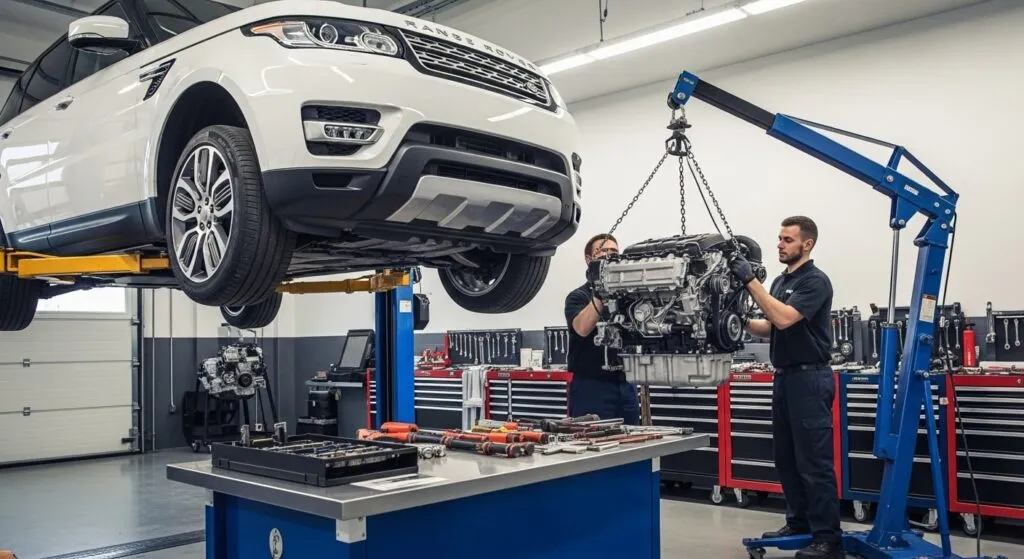
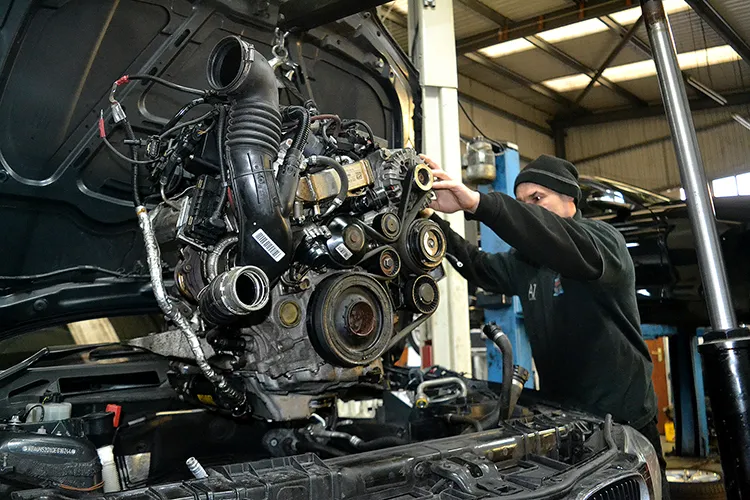

If you own a Range Rover Sport for three years or more, you will probably have heard your engine making an odd sound from beneath the bonnet, or you will be familiar with a friend or family member who does. There is a reason why garage mechanics often see this model roll into the workshop week after week.
Having worked on Range Rover Sports with the garage team that takes these units apart regularly, we have identified the faults that recur time and time again and why customers are always enquiring about Range Rover Sport engine reconditioning rather than straight repairs! Here are the facts in straightforward, plain language.
What Makes the Range Rover Sport Engine So Demanding to Maintain?
The Range Rover Sport engine was never created to be a silent, laid-back workhorse. In its several generations, Land Rover has fitted any number of V6 and V8 diesels and supercharged petrol units, each one tuned for real torque and pulling prowess.
All that performance does have a penalty. These engines run hotter, push harder, and possess a lot more sensitivity than a typical family SUV. It’s a bit like a racehorse versus a cart horse, great when all’s well, less so when not.

What Are the Most Common Range Rover Sport Engine Problems?
Ask any independent Land Rover specialist about what the typical suspects are, and you’ll hear the same few names repeated. These are the real-world factors that are responsible for the vast majority of Range Rover Sport engine problems:
Why Does Oil Sludge Wreck Range Rover Sport Engines?
No machine can run profitably without the right combination of lubricants. We all know that oil is the engine’s lifeblood, and the Range Rover engine is extremely fussy about its choice of lubricant.
-
Long service intervals are appealing, but on an engine getting numerous short runs or drag towing, the oil degrades at a rate that exceeds the planned schedule.
-
Leaks in the oil cooler will cause mixing of coolant in the oil, resulting in sludge formation which blocks oil galleries.
-
Dilution of diesel by frequent DPF burns thins out the oil and, to some extent, removes its additive properties.
When the sludge starts to build up, bearings and cam-shafts suffer for lack of lubrication; what begins as a small problem can soon turn costly.
Why Do Timing Chains Fail on These Engines?
This can be perhaps the most dreaded phrase for all Range Rover Sport owners, the most hated words of all: timing chain rattle.
Some V6 and V8 diesel models run on long chains using hydraulic tensioners. If the oil is not clean enough or at the correct pressure, it will not stay tight. Remove this deficiency and the chain stretches.
Think of that rattling noise on cold startup as your engine waving a red flag. If you continue to ignore it, you’re going to be replacing a snapped chain and bent valves and very probably also require a complete Range Rover Sport engine rebuild.
What Causes Turbocharger Failure?
Twin turbos give these engines most of their punch; they turn at incredible speeds, fully reliant on a smooth supply of oil for lubrication and cooling.
If you block or contaminate that supply, then the turbo bearings will become subject to rapid wear.
On top of that, if the turbo itself fails, the resulting copper particles are likely to be sent straight back into the engine, which could cause widespread internal damage.
Why Do EGR and DPF Issues Keep Coming Back?
This is particularly true for diesel models and can usually be attributed to driving.
-
Short trips on a regular basis prevent the DPF from regenerating.
-
Carbon deposits form inside the EGR valve, increasing back pressure and affecting power delivery and emissions.
-
A blocked DPF produces back pressure on the turbo several times.
It’s a domino effect: one blocked part silently strains the next one.
What’s Behind Coolant Leaks and Overheating?
Certain Range Rover Sport engines have plastic coolant pipes and thermostat housings, all of which have been known to go brittle with age and develop leaks.
Add a failed water pump into the mix, and overheating is a genuine concern, permanently warping cylinder heads or blowing the head gasket, mixing oil and coolant, and causing damage that is extremely difficult to reverse without a complete Range Rover Sport engine rebuild.
How Does Bearing Wear Start?
In nine cases out of ten, worn crankshaft or big-end bearings are put down to the same culprit: bad oil or lack of oil pressure.
A bottom of the engine knocking, especially under load, indicates very serious problems. It takes a very long time, if ever, for a connecting rod to actually punch a hole in the engine block, but once it gets to that point, Range Rover Sport engine replacement is the only option.
Is Range Rover Sport Engine Reconditioning Worth It?
Summary: Yes, in most cases. The reasons why specialists usually suggest this route are:
-
It’s definitely more economical than looking to get hold of the engine from Land Rover as a new one.
-
Addresses it at the source rather than merely the symptom. Problems are less likely to come back.
-
Returns the performance to factory condition: as it involves tearing down the engine and replacing components that have worn out, such as the bearings, piston rings and chains, as well as machining surfaces back to the correct tolerances, etc.
-
Trusted professionals provide a guarantee so you’re not risking your job.
A quality Range Rover Sport engine rebuild might be the best way to get rid of your engine, without the eye-watering expense of a factory replacement.

Reconditioning vs Replacement: Which Should You Choose?
It depends on how far the damage has spread. With the damage restricted to wear of individual components, such as bearings, chain, and seals, reconditioning usually wins hands down for both value and turnaround time.
If the block is cracked or grossly damaged, replacement may be unavoidable. A reputable expert will examine and honestly give you whatever advice you need, instead of trying to sell you a rebuild you don’t require.
How Much Does Range Rover Sport Engine Reconditioning Cost?
This depends on the engine version, how badly the engine has been damaged, and whether auxiliary items such as a turbo or timing chain kit need to be replaced along with the rebuild.
On average, the vast majority of owners will be able to recondition the engine for substantially less money than a new engine from the dealership, usually by saving thousands of pounds, yet with similar levels of reliability. The safest bet is always to get a written quote following inspection.
Final Thoughts
The Range Rover Sport is one hell of a beast when maintained correctly but is not a vehicle to mistreat. Oil quality, service intervals and rapid response at the first sign of trouble make the real difference.
While you’re driving one of the most highly capable performance SUVs available on UK roads, you will have to treat it with a bit more care. Treat it right and a reconditioned Range Rover Sport engine truly can outlive your original.
Frequently Asked Questions:
1. How long does the Range Rover Sport Engine Reconditioning Service take?
Reconditioning usually takes one to three weeks depending on the amount of damage and component availability.
2. Can I drive my Range Rover Sport if it makes a rattling noise when I start it?
No. A cold-start rattle means that the timing chain is worn, and it’s best not to drive on, since the chain may leap or even break when power is applied. This can lead to considerably more costly engine damage.
3. Does reconditioning come with a warranty like the new one?
Reputable specialists will do the same for reconditioned engines, but check the length of time they cover and exactly what the warranty covers before giving your vehicle up for repair.
4. Is Range Rover Sport engine reconditioning more environmentally friendly than replacement?
Yes, by reconditioning the existing engine block, it significantly reduces production demands and is a much more environmentally sustainable method when compared to the production of a fresh unit.
5. What can I do to prevent engine issues with my Range Rover Sport?
The best long-term engine maintenance tips are to stick to shorter oil change intervals than the default values, minimize short journeys, and treat warning noises with urgency.
BNS Motors Editorial Team
Expert insights on reconditioned engines, vehicle maintenance, and performance upgrades. We bring years of automotive excellence to your screen.