
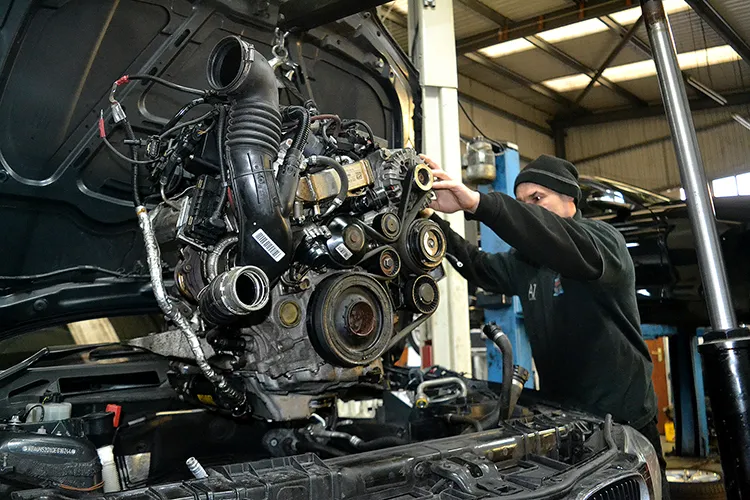

Short answer: A well-maintained Range Rover engine should easily reach 150,000-200,000 miles, and many do. The longer explanation is that this range obscures real variation; the engine behind the emblem matters more than the miles on the clock.
Understanding engine family over odometer number is the most important distinction in deciding whether an engine rebuild or engine repair makes sense.
If you are looking at a used listing asking whether 110,000 miles is "fine" or "a problem waiting to happen," or you've had a rebuild quote and you're trying to figure out whether it's justified, this is the response, engine by engine, model by model.
The Condensed Version
- General range: 150,000–200,000 miles; maintenance practice counts more than sheer age.
- The TDV6/SDV6 diesels are basically sound but use timing belts instead of chains, which must be replaced, without exception, at around 90,000–110,000 km.
The weakest engine in the series is the 2.0-liter four-cylinder Ingenium, utilized in the Range Rover Evoque, Velar, Land Rover Discovery Sport and some Sport versions, mainly due to oil dilution and timing chain attrition.
The 3.0-liter six-cylinder Ingenium (P400 petrol, D300/D350 diesel) is considerably more powerful than its brother.
Rebuilds and reconditioning aren't the same, but both have criteria that affect your inquiries.
The mileage alone will not tell you exactly how healthy the engine is. The engine's full service history will be of more use than a figure on the odometer.
How Long Does Every Engine Truly Run?
Range Rover TDV6 Engine Life:
The 2.7L and 3.0L TDV6/SDV6 diesels are well respected, with the crankshaft, block, and pistons generally holding up well to high miles.
The TDV6 has two timing belts, one for the fuel pump and the other for crank/cam timing, instead of a chain, which can surprise owners. If you miss the belt replacement interval, which usually falls between 90,000 and 110,000 miles, a broken belt can destroy the engine in seconds with no warning.
Keep in mind that these two belts fail differently. The front crank(cam belt causes piston-to-valve contact, which usually means a complete rebuild. The rear fuel pump belt stops the engine from functioning. But it's a smaller, cheaper problem that's easy to fix.
A realistic, ordinary expectation for a TDV6 is 150,000 to 200,000+ miles, handled correctly with timely belt changes and up-to-date oil changes.
Range Rover Ingenium Engine Reconstruction Expectations (2.0-liter):
This engine warrants the most caution. Oil dilution—unburnt fuel from stopped DPF regeneration cycles thinning the oil—accelerates wear on the timing chain, turbo, and cylinder rings of the 2.0-liter four-cylinder Ingenium diesel.
It usually happens during short, low-speed trips, which don't allow the DPF to reach the temperature it needs to burn off soot. Ultimately, the engine forces regeneration with extra fuel, and if this cycle gets interrupted mid-drive, some soot ends up in the sump rather than the exhaust.
Some owners have reported major problems long before the belt-driven TDV6 timetable was left uncontrolled. If the oil level rises between services instead of dropping gradually, it's a classic sign of dilution underway.
Quiet and less spectacular, the 2.0-liter petrol Ingenium has occasional misfires and more oil use at higher mileage, but nothing like the diesel's noted flaws. Petrol variants don't run a DPF, so the dilution mechanism doesn't apply here.

Range Rover P400/D300 Engine Reliability (3.0-liter six-cylinder):
Things get significantly better when you switch to the 3.0-liter inline-six Ingenium: P400 gasoline and D300/D350 diesel. Better heat control, a stronger bottom end, and a DPF installation that helps reduce many of the oil dilution issues afflicting the smaller diesel. The larger displacement also means the engine works less hard for a given load, which ultimately equals lower average stress over time.
It's not totally without known problems; on certain early models, a stretched timing chain tensioner may cause a cold-start rattle, so it's not a "sit back and forget about it" area. This rattling sound disappears once oil pressure builds, but ignoring it over time will only cost you more.
But as a class, the six-cylinder Ingenium is much more dependable than its namesake four-cylinder sibling.
Based on Model: What Are You Purchasing?
Model |
Typical Engines |
Lifespan Outlook |
Watch For |
|
Range Rover Evoque |
2.0L Ingenium (petrol/diesel) |
120,000–160,000 miles with careful maintenance |
Oil dilution on diesel variants, timing chain wear |
|
TDV6/SDV6, or P400/D300 Ingenium |
150,000–200,000+ miles depending on engine |
Timing belt interval (TDV6); chain tensioner (Ingenium six-cyl) |
|
|
2.0L Ingenium, some P400 |
120,000–160,000 miles typical |
Same oil dilution risk as Evoque on 2.0L diesel variants |
A Range Rover Sport engine rebuild and a Range Rover Evoque engine rebuild are entirely different conversations; they're often not even the same engine family, and a mileage number that raises eyebrows on one is completely normal on the other.
This is why a single "expected mileage" for a whole range is misleading. The badge tells you nothing about engine condition, so checking the logbook is the only way to know.
What exactly reduces or increases engine life?
The engine family is the baseline: How you really use it is what gets you to that baseline. Or over it. Or much under it.
Reduces lifespan:
- Many quick trips never let a diesel finish a complete DPF regeneration.
- Extending oil change intervals beyond what the engine's real state calls for
- Ignoring early warning signals —a tick, a light, a smell—instead of getting it tested.
- Constantly using wrong oil specifications. These engines demand specific low-friction oil grades, and even the closest substitute can increase the risk of timing chain and turbo bearing failure.
Helps one live longer:
- Regular motorway-length runs allow diesel regeneration to finish appropriately.
- If you're mainly driving short city trips, stick to or cut out oil change intervals.
- Approach timing belt/chain maintenance proactively, not reactively.
- If you want persuasive evidence when you sell the car or negotiate a rebuild quote, keep a written logbook separate from the service history.
Indicators You Are Getting to Rebuild Territory:
- A cold-start tick or rattle not present a year ago
- Oil level increasing instead of decreasing (typical dilution indicator on 2.0L diesel engines)
- Loss of power or significantly rougher idle than when you first purchased it
- Approaching the 90,000–110,000 mile range on a TDV6 lacking a recorded belt replacement
- Reaching 100,000 miles on a 2.0L Ingenium diesel with no notable engine care at all
- A noticeable difference in exhaust smell or color under load. An intermittent symptom is still the real one.
None of these point to a definite rebuild for tomorrow. They mean it's time for a thorough look, not a guess. The cost of "that look" is obviously a fraction of the cheapest repair on this list. So listen to what your car is saying before it screams.
Rebuilding vs. Reconditioning: What's the Real Difference?
We often confuse these two terms, which have completely different meanings and procedures:
Engine Rebuilding: Usually your exact engine is disassembled, worn parts are replaced or machined back to spec, and it is put back together and mounted to your vehicle; the same physical unit, rebuilt.
Engine Reconditioning: More often, a distinct unit, already stripped, checked, rebuilt to a consistent standard, and provided ready to fit, is exchanged in place of your first engine (or its useful components).
Your unique fault, your budget, and how long you want to keep the car all help determine which path makes the most sense; a decent expert will discuss which option best suits your needs rather than automatically choosing whichever is most profitable for them.
Another point to mention is the time duration. Installing a reconditioned engine is normally a simple operation, and it'll be ready to go in, so you'll spend less time off the road. But a full engine rebuild is a complicated, lengthy job that needs to be done accurately.

When Should You Get a Specialist?
If you fall within the mileage ranges above, or if any of the red flags strike a chord, a correct diagnosis pays for itself. Before recommending anything, a real Land Rover engine rebuild expert will examine oil dilution levels, compression, and timing belt/chain condition; not only quote for the most costly choice since you inquired about the noise. A specialist will ask for any service history before opening the engine, prior work or the lack of it, and often narrow down the likely reason.
If you are looking for a Land Rover engine rebuild near me, look for independents with JLR experience rather than a general all-makes garage, as the diagnostic equipment and belt/chain work on these engines are specific enough that general knowledge may not always translate. Don't just ask about familiarity with your model; ask about your exact engine code. Expertise with TDV6 belts does not translate into Ingenium diagnosis.
Frequently Answer Questions:
1. How many miles can a Range Rover engine actually do?
With good care, most engines in the range will easily exceed 150,000–200,000 miles. But the exact number mostly relies on which engine you have—TDV6, four-cylinder Ingenium, or six-cylinder Ingenium. Two vehicles of the same age and model can differ by engine variant alone.
2. Is 100,000 miles too much for a Range Rover?
100,000 miles falls within a reasonable range for a TDV6 or a six-cylinder Ingenium with full service history. At 2.0L, this type is renowned for oil dilution concerns at this mileage, so a closer look at a diesel with unknown service history is recommended. Checking service history is the key.
3. Should I stay away from purchasing a high mileage Range Rover?
Not automatically. A high-mileage TDV6 with documented belt changes may be a safer purchase than a lower-mileage Ingenium diesel with sporadic maintenance. The odometer reading matters less than the maintenance history.
4. Does a rebuild cost less than a complete engine replacement?
Generally yes. A rebuild or reconditioning uses more of the engine's existing structure, avoiding the higher cost of a brand-new unit. Still, the actual savings depend on the degree of damage found once it is opened up. Always get a written estimate before starting any work.
5. Where can I find a reliable expert nearby?
Ask for JLR-specific experience, clear diagnostic results before any work is carried out, and a guarantee on the end product; a proper Land Rover engine rebuilder will tell you what he found, not just what he is charging for. As a rule, a good specialist, confident in his work, will give you a written warranty.
BNS Motors Editorial Team
Expert insights on reconditioned engines, vehicle maintenance, and performance upgrades. We bring years of automotive excellence to your screen.