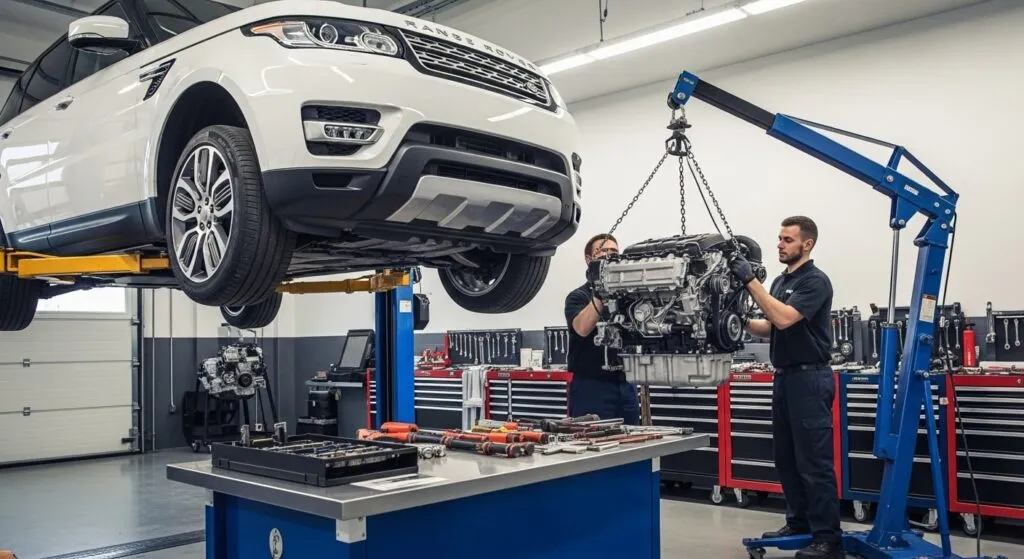
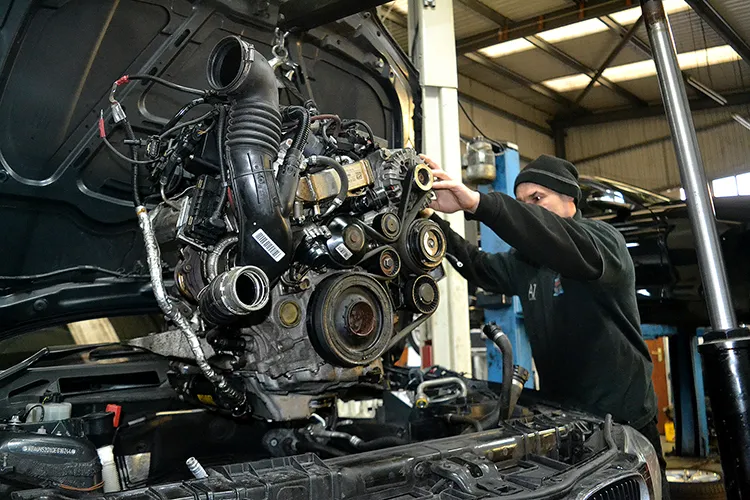

Ask three Range Rover owners how frequently they change their engine oil and you’ll get three different responses, all confidently delivered and still wrong for the vehicle sitting on their driveway. Because Range Rover engine maintenance is not one plan. An Ingenium diesel doing the school runs around the M25, a supercharged V8 that only comes out on weekends, and an older TDV6 with 140,000 kilometers all have really different failure mechanisms; treating them the same is precisely how a well-intentioned owner gets an unexpected bill.
This is the version that really divides the advice by engine, with actual intervals rather than estimated numbers, and a direct analysis of the price of preventative care versus neglect.
The Quick Summary:
- Every engine depends on basic principles like the right oil spec, a cooling system examination at every maintenance, and proactive diagnostics instead of reactive ones.
- Ingenium diesels have one particular risk: oil dilution resulting from stopped DPF regeneration on short trips. Look for rising oil levels instead of falling ones.
- V8 supercharged engines cause stress on the cooling system (crossover pipe, water pump, coolant reservoir) and a straight relationship between stretched oil intervals and timing chain tensioner wear.
- Diesel TDV6/SDV6 engines run belts instead of chains; their 90,000–110,000 mile belt window is determined by age and heat cycles rather than only mileage; missing it often results in engine replacement rather than repair.
- The real intervals are better than the recommended ones: specialists recommend 8,000 to 10,000 miles for diesel fuel in urban areas and 5,000 to 6,000 miles for the V8, which is significantly less than 16,000 to 21,000 miles offered by the car manufacturer.
- The price difference stays the same for all types of engines: preventive servicing costs hundreds of dollars while negligence costs thousands.
The Basics — Applicable to Every Engine:
Three factors count irrespective of what is beneath the bonnet before the engine-specific information:
- Oil discipline: Not only changing it at times, but also using the right specification—usually 0W-20 or 5W-30 fully synthetic, as Land Rover specifies—and not stretching the interval based on assumptions about your driving style is the oil discipline—more on just how far to stretch it here since the honest response varies per engine.
- Cooling system health: By design, every engine in this line runs hot; every one of them has a documented cooling-related flaw. At every service, a five-minute visual inspection of coolant level and colour helps most problems be noticed before they become head gasket headaches.
- Diagnoses are proactive, not reactive. Each service, not only when there is a problem at hand, includes a test that reveals sensor drift and early fault codes before they become costly problems to solve. If you’re waiting for the light to go off, you are already behind the times.
Having addressed that, the actual contrasts begin here.
Worth highlighting before the engine-specific analysis: a recorded maintenance history, invoices instead of only a stamped book, counts twice over. It protects any warranty claim since JLR and most extended warranty providers can reject a claim if maintenance cannot be proven; on a car in this price range, a buyer comparing two comparable-mileage cars will pay a real premium for one with a traceable paper trail.

Range Rover Ingenium Maintenance: The Oil Dilution Issue:
If you’re driving a 2.0-litre four-cylinder or 3.0-litre six-cylinder Ingenium diesel, there’s one problem worth learning by name instead of grouping it into general check your oil advice: oil dilution.
Here is the real process: Short, low-speed trips- precisely the pattern of a London or Essex commute, stop-start traffic, the school run- prevent the diesel particulate filter from reaching the temperature it requires to burn off caught soot. The engine adds more fuel to drive a regeneration cycle. If you have reached your destination before that cycle finishes, unburnt diesel will thin the oil in the sump instead of leaving through the exhaust. Oil that has been diluted loses its ability to lubricate, and that thinner film speeds up wear on the timing chain, turbo, and cylinder rings—exactly the parts that turn an inexpensive repair into a pricey one.
Once you know to look for it, your oil level rising between changes instead of the normal slow decrease is the clear sign. Check the dipstick at every fuel stop for the first few months of ownership until you know your car’s normal pattern.
Real interval: Land Rover’s official mileage for diesel Ingenium engines is 21,000 miles or two years, whichever comes first, assuming mixed driving with regular longer trips. That number is hopeful for the true demands of your engine if most of your actual pattern is short metropolitan trips. For mostly metropolitan application, independent experts working on these engines daily typically advise lowering it to 8,000–10,000 miles. Petrol Ingenium engines run a longer official interval of 16,000 miles/12 months and don’t carry the DPF-related dilution risk as they don’t operate a particulate filter at all.
Beyond the oil change itself, what truly helps is a real, practical custom of a real 20–30 minute motorway-speed run every several weeks that lets a diesel Ingenium finish a full regeneration cycle unmolested. Tell your Range Rover specialist this clearly at your next service if your ownership pattern really doesn’t allow that(short excursions only, no realistic motorway access); some may suggest shortening the interval still more or doing an oil analysis at every change to monitor dilution directly instead of depending on mileage alone.
Range Rover V8 Engine Maintenance: Cooling Under Continual Work:
The 5.0-liter supercharged V8 has quite a different set of priorities. Though it stresses its cooling system to a degree the diesel versions don’t experience, this engine isn’t at risk from oil dilution—there isn’t a DPF regeneration cycle to disrupt.
The patterns seen in UK-driven vehicles include:
- Coolant crossover pipe failure
- Wear on the water pump
- Leaks from the thermostat housing, and a plastic coolant reservoir that hardens and cracks with age, causing slow enough leaks that they go undetected until the temperature gauge moves.
- The other well-known thing, Supercharger snout bearing wear, is an early indication —a whining or rattling sound from the supercharger itself is not something to file under “characterful engine noise”.
With respect to this particular engine, there is a clear, well-documented relationship between oil changes and tensioner wear in that individuals who stretch their time out close to the 16,000-mile mark experience a much higher incidence of tensioner rattle than others who don’t.
Real interval: The official number of 16,000 miles or 12 months was determined based on a mixed-use assumption that doesn’t hold for a car doing occasional, hard-driven weekend miles rather than steady daily use—exactly the pattern a V8 kept as a reward car tends to fall into. Long-term V8 owners and experts always advise cutting this to 5,000–6,000 miles, therefore seeing the official number as a ceiling one should undercut rather than a goal to attain.
What really helps is a coolant system check at each oil change, not just at the full yearly service; it helps to detect a crack far before it turns into a leak and takes two minutes to check reservoir state, hose flexibility, and coolant colour. Also, it’s worthwhile letting the engine idle for a minute before you leave cold and avoiding hard acceleration until the temperature gauge has settled—a behavior that costs you nothing in real terms but significantly lowers thermal shock on a chilly supercharger and its bearings.
Range Rover TDV6 Repair: The Belt Interval Not Forgiving:
The basic components of an elderly TDV6 or SDV6 diesel—crankshaft, block, pistons—have real proven resilience. What sets this engine apart is a date-stamped maintenance item—the timing belt.
Unlike the chain-driven Ingenium models, the TDV6 runs two timing belts instead of a chain: one for fuel pump timing and one for crank/cam timing. This is the most important period on this entire list, as a neglected belt change impairs gracefully. Once that has occurred, a broken crank/cam belt causes immediate piston-to-valve contact; rarely is there a repair option—it is a replacement discussion rather than a repair one.
True value, not the approximate one: This task of replacing the belt is done somewhere in the range of 90,000-110,000 miles; however, this is a mandatory task that cannot be delayed based on how gently the driver has been driving the car, since the material of the belt becomes weaker because of the effects of time and temperature cycles.
Specifically for oil changes, the official interval for the TDV6 is also around 16,000 miles; the same reasoning applies as with the V8: UK stop-start and towing usage drive professionals to advise 8,000–10,000 miles instead, especially considering how directly oil condition impacts turbo and crankshaft bearing longevity on this engine.
Maintenance Cost vs. Neglect Cost:
Numbers make this argument better than a paragraph of warnings does:
Habit |
Proactive Cost |
Cost If Neglected |
|
Oil and filter change (any engine) |
£150–£250 |
Accelerated wear across turbo, chain, bearings |
|
Ingenium timing chain kit, caught early |
£1,500–£2,500 |
Full engine replacement: £2,500–£7,000+ |
|
TDV6 timing belt service, on schedule |
Roughly £600–£900 |
Full engine replacement: £4,200–£7,600 |
|
V8 coolant system check/repair |
£150–£400 per component |
Head gasket failure, warped heads: £3,000+ |
Every engine in this spectrum shows the same pattern: the proactive habit costs a small portion of what the ignored one does, and the difference is always a multiple of ten or more.

A Straightforward Approach for Extending Range Rover Engine Longevity:
In addition to the points raised above, there is no cure-all, but the summary deserves mention: tailor your service interval based on your driving behavior rather than the positive default set by the computer; identify the single issue that exists in your engine instead of looking at engine care as a generic activity; and treat the belt/chain replacement as set rather than flexible.
Regardless of which of these three families it hails from, a well-kept Range Rover engine ought to readily pass 150,000–200,000 miles. The owners who fall short of that number are rarely unlucky; most of the time, they are simply operating from the wrong interval for how they actually use the car, applying a mixed-use assumption to a driving pattern that never resembled mixed use in the first place.
Commonly Asked Questions
1. How frequently should I change the Range Rover’s oil?
The mileage depends on the model of the engine and the driver’s style. The official data varies from 16,000 to 21,000 miles. However, according to professionals, the distances should be cut down to 8,000-10,000 miles for diesel engines and 5,000-6,000 miles for the V8 engine due to its cooling system and timing chains.
2. What is oil dilution and why does it affect only certain engines?
Oil dilution is the result of unburnt diesel from an interrupted DPF regeneration cycle thinning the engine oil. Diesel Ingenium engines only, as the V8 and petrol models do not run a particulate filter and therefore do not undergo the regeneration process at all.
3. Is the timing belt of the TDV6 really so important?
Yes—unlike a timing chain, the TDV6’s belts deteriorate with age independent of mileage; a broken belt results in immediate, usually irreparable internal damage. The 90,000–110,000 mile range should be considered a hard limit, not a recommendation.
4. Can I prolong my Range Rover’s engine life by only driving differently?
To a significant extent, yes. Regular longer runs let a diesel Ingenium complete DPF regeneration properly, and consistent gentle warm-up before hard acceleration reduces thermal stress on the V8’s cooling system — both genuinely reduce wear beyond what servicing alone can fix.
5. Which maintenance recommendations really apply to my engine?
Range Rover covers Ingenium four- and six-cylinder units, the 5.0 V8, and older TDV6/SDV6 diesels—each with distinct risk factors—so check your particular engine code, not only the model name. An expert familiar with your particular engine will pay attention instead of using a universal timetable.
BNS Motors Editorial Team
Expert insights on reconditioned engines, vehicle maintenance, and performance upgrades. We bring years of automotive excellence to your screen.