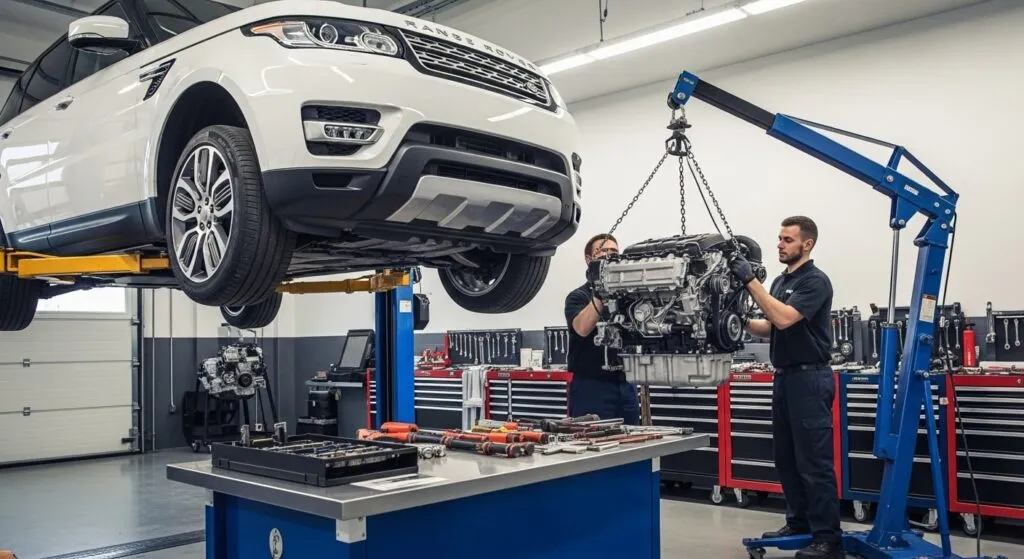
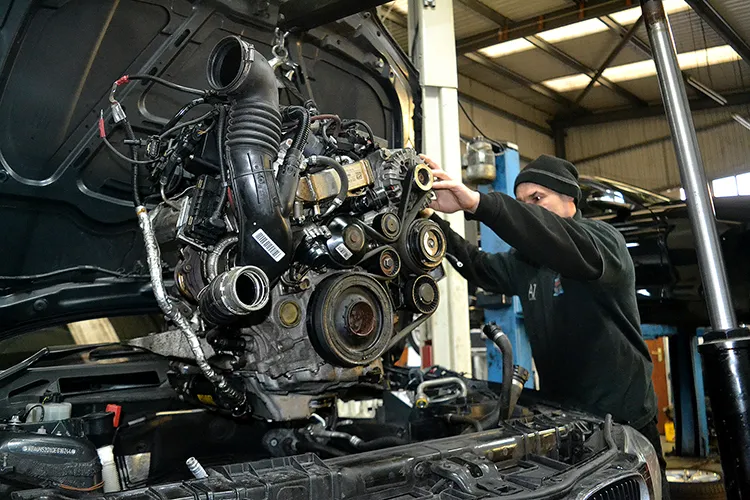

If your Discovery’s just failed a diagnostic and the word “replacement” has entered the conversation, the honest first answer is: it depends heavily on which generation you’re driving. Discovery 3 engine replacement cost from UK independent specialists typically is about 4,200-6,500 supply and fit, a Discovery 4 engine replacement cost is closer to 4,500-7,600 due to the more labour-intensive SDV6, and a Discovery Sport with an Ingenium engine can attract anything between roughly 2,500 and 7,000 depending on how far the damage has progressed before it is caught.
All these costs are estimates which vary upon vehicle damage and parts availability. Main dealer pricing generally sits well above all three, sometimes into five figures once parts, labour, and VAT are totalled. So if your Discovery has raised a white flag and there is no solution other than engine replacement, keep reading and take notes!
The Short Version:
- Discovery 3 engine replacement cost: roughly £4,200–£6,500 at independent specialists, mainly for the 2.7 TDV6.
- Discovery 4 SDV6 engine replacement: roughly £4,500–£7,600, crankshaft failure jobs at the top end given the labour involved.
- Discovery Sport Ingenium replacement: roughly £2,500–£7,000 — a wide range because it depends on whether it’s a preventative chain job or a full rebuild.
- Figures above are guides based on published UK specialist quotes, not fixed prices — get an exact quote for your fault and vehicle.
- Parts availability differs hugely by generation: Discovery 3 parts are scarcer than Discovery Sport’s newer, larger supply network.
- The biggest cost lever across every generation is timing: catching a fault at the “rattle” stage is consistently cheaper than catching it after catastrophic failure.
Land Rover Discovery Engine Replacement Average Cost by Generation:
Generation Common Engine Average UK Specialist Cost (supply & fit) What Drives the Price
Discovery 3 2.7 TDV6 £4,200 – £6,500 Parts scarcity — engine long out of production, sourcing takes longer.
Discovery 4 2.7 TDV6 / 3.0 SDV6 £4,500 – £7,600 Crankshaft failure severity; SDV6 jobs run roughly 16 hours of skilled labour.
Discovery Sport 2.0 Ingenium £2,500 – £7,000 Huge range depending on whether it’s chain repair, rebuild, or full replacement.
These figures are average costs which reflect independent specialist supply-and-fit quotes rather than main dealer pricing, and move depending on your fault, trim, and whether a used, reconditioned, or new unit is fitted. Reconditioned tends to sit mid-range, used at the lower end, and new dealer-supplied well above the top. Confirm exactly what’s included before comparing quotes — a lower headline figure sometimes excludes parts that turn out necessary once the old engine is out.

Discovery 3 Engine Problems & Replacement (Td4 & TDV6):
Quick clarification worth making upfront: the UK Discovery 3 was never actually offered with a Td4 engine — that unit belongs to the Freelander 2 and later Discovery Sport. Every UK-market diesel Discovery 3 ran the 2.7-litre TDV6, so “Td4 vs TDV6 reliability” is really comparing two different vehicles’ engines, not two options within the Discovery 3 range.
The 2.7 itself has a known weakness: the oil pump casing cracks and wears the crankshaft bearings with lack of lubrication… especially on service-scheduled vehicles that stretch intervals, rather than follow them strictly. When oil flow drops below the amount the engine’s bearing surfaces require… even for a very short time, wear silently builds up until a bearing spins or the crank fails due to fatigue - at which point the crank has almost always already scored the block.
Add to that EGR valve clogging, turbocharger faults (frequently linked to Technical Service Bulletin LTB00452, addressing TDV6 turbo oil starvation), and a known weakness in the plastic coolant system components, which harden and crack with age. These secondary faults can compound a bigger problem left alongside it — a cracked coolant pipe can starve the engine of proper cooling right when the crankshaft bearings are least able to tolerate extra stress.
Why does a Discovery 3 engine replacement cost tend to sit differently from later generations?
Largely parts availability — the 2.7 TDV6 has been out of production for well over a decade, narrowing your sourcing options versus newer units still pulled from recent write-offs. Specialists keeping dedicated stock tend to turn a job around faster than those sourcing on demand.
Discovery 4 Engine Replacement (SDV6):
The Discovery 4 ran the same 2.7 TDV6 early on before moving to the 3.0-litre SDV6, and both carry their own well-known failure point: crankshaft bearing failure caused by inadequate oil flow to the rear main bearings under sustained high-load conditions — a fault Land Rover itself acknowledged in a technical service bulletin without ever issuing a formal recall. Towing and heavy off-road use, both common on this generation, accelerate the risk considerably compared with a Discovery 4 used mainly for gentle motorway commuting. The crankshaft’s relatively narrow, compact design creates weak points between the rod bearing journals and counterweights — a design characteristic rather than a manufacturing defect, which is why the failure can appear even on well-serviced examples, though poor maintenance and aggressive driving both measurably increase the risk.
Alongside crankshaft wear, timing chain rattle, EGR cooler leaks, and turbo actuator faults show up regularly on Discovery 4s of this era — each with its own warning pattern, which is why a proper diagnostic checks all of them together rather than assuming one fault explains every symptom.
What actually pushes a Discovery 4 SDV6 engine replacement decision over a repair?
Mainly whether the crankshaft has already scored the block; if caught early, a specialist may intervene with a repair rather than a full swap. Once metal-on-metal contact has happened, rebuilding is rarely viable — one reason this generation’s jobs sit at the higher end of the cost table, with a full long-engine supply-and-fit typically running around 16 hours of skilled labour, covering removal, a thorough clean of the oil and cooling systems, fitting, and ECU reprogramming before a road test.
Discovery Sport Ingenium Engine Issues:
The Discovery Sport’s 2.0-litre Ingenium diesel is a genuinely different animal from the TDV6/SDV6 units above — newer design, different failure mode entirely.
The headline issue is oil dilution: short, low-speed journeys don’t let the diesel particulate filter reach the temperature it needs to burn off trapped soot, so the engine injects extra fuel to force a regeneration cycle. If that cycle gets interrupted mid-drive, unburnt diesel ends up thinning the oil in the sump rather than exiting through the exhaust. Diluted oil loses its lubricating properties, which accelerates wear on the timing chain, turbo, and cylinder rings — the classic Ingenium red flag is oil level creeping up rather than the usual gradual drop.
This is a fundamentally different problem from the TDV6/SDV6’s wear-and-tear failures above. Where a TDV6 crankshaft fails from oil starvation under sustained load, the Ingenium’s issue is largely a byproduct of short urban driving — school runs, quick shopping trips, stop-start commutes. A Discovery Sport used mostly for short local journeys is arguably at higher risk than one doing regular motorway miles — the opposite pattern from the older diesels.
Therefore, a very wide cost spectrum for the Discovery Sport timing chain service. In the case when this service is done while the vehicle is still wearing, then the cost of the preventive kit is about 1,500-2,500, which is quite a reasonable service. But wait until the chain skips or breaks and the pistons beat the valves with force – and then the time has come for the full replacement.
Signs Your Discovery Needs an Engine Replacement
Knocking or grinding noises — usually bearing wear or, on TDV6/SDV6 units, an early warning of the crankshaft bearing failure pattern above. Not a noise to “keep an ear on” for a few more weeks.
Smoke from the exhaust— blue smoke means oil is burning, often worn seals or turbo failure. Black smoke usually points to a fuel or turbo fault. Either sustained for more than a moment is worth a diagnostic — a brief puff of white smoke on a cold morning is usually just condensation.
Overheating or rising coolant loss— on Discovery 3/4 models, this often traces back to the brittle plastic coolant components mentioned earlier, or a failing water pump. Left unaddressed, it risks head gasket damage.
Rising oil consumption or oil level— on TDV6/SDV6, oil disappearing faster than expected points toward oil starvation. On Ingenium units, an oil level that’s climbing is the dilution tell described above — two very different mechanisms, same symptom.
Warning lights — an amber engine light often means a sensor fault worth checking soon. A red oil pressure or temperature warning means stop the vehicle as soon as it’s safe — continuing to drive on it reliably turns a repairable fault into a replacement.

What Affects the Cost of a Discovery Engine Replacement?
New vs. used vs. reconditioned— a brand-new dealer unit sits well above a good used engine or a professionally reconditioned one, which is why most owners choose between the latter two. Reconditioned offers a middle ground: stripped, inspected, and rebuilt to a consistent standard rather than pulled from another vehicle with unknown condition.
Labour complexity by generation— SDV6 and later Ingenium units involve more ancillary systems to disconnect than the simpler TDV6, adding to labour time before parts cost is even factored in. Ask for an estimated labour time as part of any quote.
Parts availability — this matters most by generation. Discovery 3 parts are harder to source given how long the model’s been out of production, while Discovery Sport parts move through a larger, more current supply network — affecting both price and turnaround time.
Choosing a Land Rover Discovery Engine Specialist:
A few concrete things worth checking rather than taking on trust:
- OEM or OE-equivalent parts, not unbranded budget components — ask specifically what’s being fitted.
- A written warranty on both parts and labour, not just the engine itself — 12 months is a common standard, with some offering unlimited mileage cover.
- JLR-specific diagnostic equipment — generic OBD scanners read a code but won’t run the deeper active tests these engines need.
- Documented experience with your specific engine (not just “Land Rover experience” in general). A TDV6 specialist who is comfortable working on crankshafts is not necessarily the right person for an Ingenium diagnosis, and vice versa.
A specialist worth using should be able to explain what they found on your vehicle, not just hand over a quote — a garage that can’t explain why a job costs what it does is a yellow flag in itself.
Frequently Answer Questions:
1. How much does a Discovery 4 engine replacement cost?
Costs vary depending on whether it’s a TDV6 or SDV6 and how extensive the crankshaft damage is. Full crankshaft failure jobs sit toward the top given the roughly 16 hours of labour involved.
2. How much does a Discovery 3 engine replacement cost?
Costs are pushed up by parts scarcity, since the 2.7 TDV6 has been out of production for years, which can extend the job’s timeline too.
3. Are Ingenium engines in the Discovery Sport reliable?>
Broadly yes, provided oil dilution is managed — sticking to approved oil and not stretching service intervals matters more here than on older diesels. It’s a well-documented weak point, not a flaw affecting every unit.
4. Can a Discovery engine be repaired instead of replaced?
Often, if caught early. A rattle or rising oil level flagged promptly might mean a component-level repair — a preventative Ingenium timing chain kit runs £1,500–£2,500 rather than a full replacement. Once crankshaft scoring has occurred, replacement usually becomes the only option.
5. How long does a Discovery engine replacement take?
Timeframes vary by generation and parts sourcing — a reconditioned unit ready to fit is generally quicker than sourcing a specific used Discovery 3 engine, with some specialists quoting full fitting within 48 hours once parts are in hand.
BNS Motors Editorial Team
Expert insights on reconditioned engines, vehicle maintenance, and performance upgrades. We bring years of automotive excellence to your screen.